
Control Is the New Cloud
What recent cloud acquisitions reveal once you stop reading the headlines

Every few years, cloud pretends to be boring.
Margins stabilize. Architectures standardize. The headlines shift to something shinier. And then, quietly, underneath the noise, the center of gravity moves.
By the time most people notice, the game is already being played somewhere else.
That is where we are again.
Cloud Is No Longer the Prize
For much of the 2010s, cloud acquisitions followed a predictable arc.
A missing SaaS module.
A capability gap.
A product roadmap shortcut.
Between roughly 2013 and 2019, cloud M&A was largely about completion. Vendors were assembling suites. Hyperscalers were filling blanks. The logic was additive.
That logic broke sometime after 2022. What replaced it is more subtle, and far more important.
The current wave of acquisitions is not about cloud as a destination. It is about control over how the AI era consumes cloud.
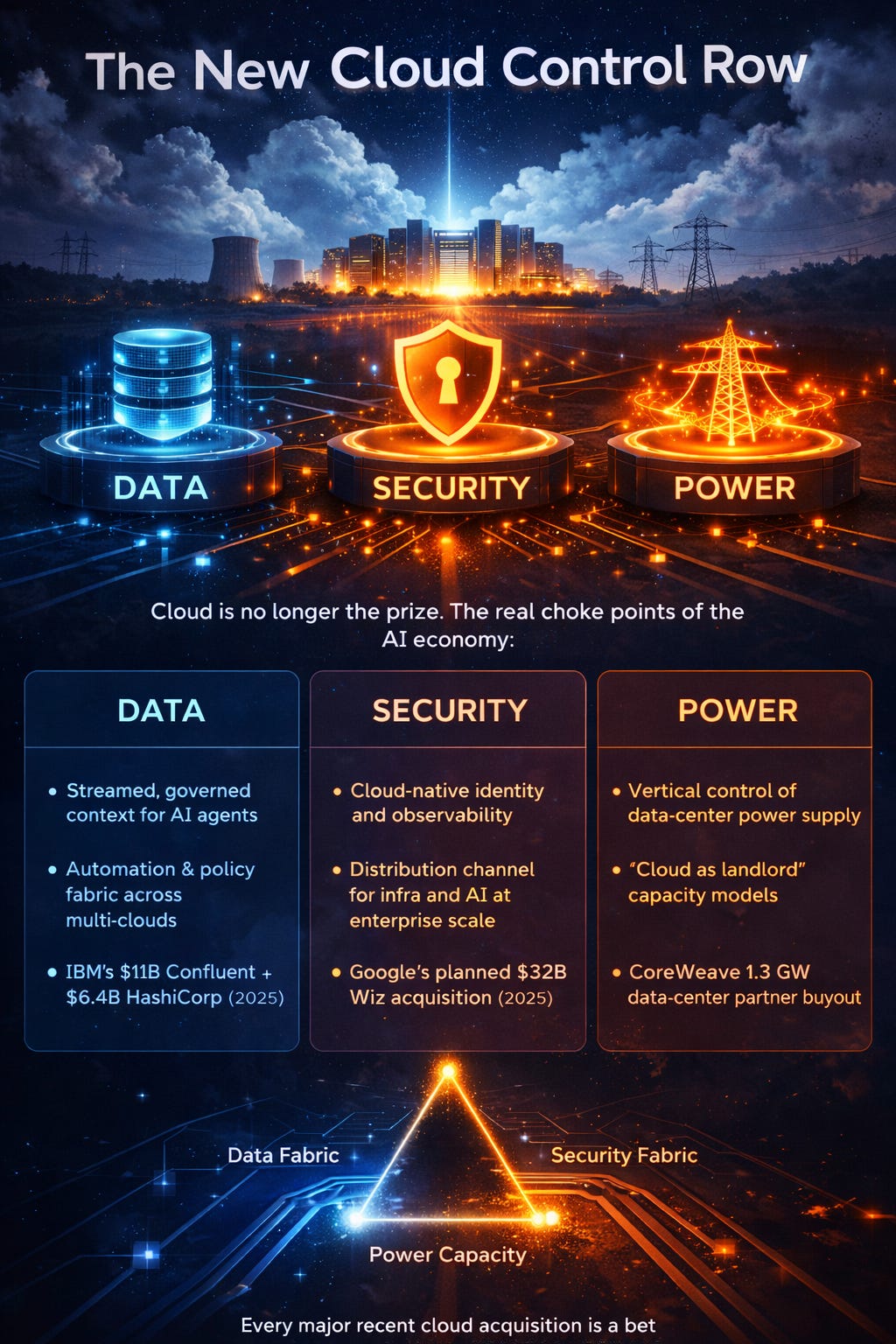
Data.
Security.
Power.
Those are the only three things that matter now.
A Pattern Appears (2019–2025)
If you line up the most consequential cloud and infrastructure deals from the last few years, a pattern emerges that is impossible to unsee once you notice it.
Not “more features.” Not “better UX.” But ownership of chokepoints.
Data as the Control Plane (2024–2025)
In December 2024, IBM announced its intent to acquire Confluent for approximately $11 billion, with the transaction expected to close in 2025.
Officially, this was framed as a move into “smart data platforms for enterprise generative AI.”
Unofficially, it was something else.
Enterprise AI agents do not fail because models are weak.
They fail because context is stale, fragmented, or ungoverned.
Event streams are no longer plumbing. They are the nervous system through which AI perceives reality.
This deal only fully makes sense when paired with IBM’s earlier acquisition of HashiCorp, completed in 2023–2024 for $6.4 billion.
Together, Confluent and HashiCorp form something larger than the sum of their parts:
Streaming context
Infrastructure provisioning
Policy and governance
Hybrid and multi-cloud reach
This is not a data strategy.
It is an AI operating spine.
Security Stops Being Defensive (2023–2025)
In mid-2024, Google announced a definitive agreement to acquire Wiz in a deal reportedly valued at ~$32 billion, pending regulatory approval into 2025.
Calling this a “security acquisition” misses the real story.
Wiz sits at the one place every enterprise eventually centralizes:
What do we actually see across all our clouds?
That vantage point is priceless.
Whoever owns it shapes:
Which workloads are considered safe
Which architectures pass audits
Which clouds feel “simpler” to adopt for AI
Security, in this phase of cloud, is no longer about protection.
It is about distribution and architectural influence.
You see the same logic in Palo Alto Networks’ acquisitions between 2022 and 2024, including identity, observability, and AI-adjacent security assets.
Identity plus telemetry plus policy equals leverage.
Power Quietly Takes the Throne (2023–2025)
The least discussed, most decisive shift happened below the software layer.
Between 2023 and 2024, CoreWeave moved to acquire and vertically integrate with its largest data-center partner, securing control over approximately 1.3 gigawatts of power capacity while eliminating nearly $10 billion in long-term lease obligations.
This was not a financial optimization.
It was a declaration that AI infrastructure had entered a new phase:
Cloud providers cannot remain pure renters
Power is now a first-class constraint
Location, energy pricing, and regulation shape product strategy
By 2024, multiple industry forecasts projected data-center power demand increasing by well over 100% by 2030.
Cloud, at this point, starts to resemble energy markets more than SaaS.
What This Says About Cloud’s Maturity
This is not late-stage consolidation.
It is post-feature maturity.
By 2023, buyers had largely stopped paying premium multiples for isolated tools. Instead, they began overpaying for anything that:
Governs complexity
Orchestrates systems
Sits in the execution path of AI workloads
The distance between software, infrastructure, and capital collapsed.
When SoftBank acquired DigitalBridge in 2024 for approximately $4 billion, it was not a venture bet.
It was a balance-sheet thesis on AI infrastructure economics.
The New Cloud Stack (2025 Forward)
By 2025, the cloud stack that actually matters looks like this:
Data fabric that feeds AI agents in real time
Security and identity fabric that governs trust and action
Power and physical capacity that constrain everything above it
Not compute. Not storage. Not regions.
End-Goal: Control.
Where the Next Acquisitions Will Come From (2026–2029)
If the last two years were about securing foundations, the next phase is about refinement.
Expect clustering around:
1. Agent-Ready Data & Workflow Platforms
Especially in regulated industries where AI must operate under explicit constraints.
2. Embedded AI Governance
Policy engines that sit inside identity, SASE, and network layers rather than beside them.
3. Power-Aware Cloud Software
Workload orchestration driven by energy cost, carbon intensity, and latency—not just price per hour.
A Note to Founders
The uncomfortable truth is this:
If you are “just another cloud tool,” you are in a shrinking market.
The companies being acquired at premiums between 2023 and 2025 share four traits:
Credible multi-cloud neutrality
Placement at decision choke points
Governance as a core UX surface
Pricing indexed to real economic levers
A simple test:
If your product vanished tomorrow, which high-stakes decisions would become blind?
That answer tells you whether you are building leverage or decoration.
A Note to Investors
The mistake now is to treat cloud as settled and AI as additive. They are fused. From 2025 onward, cloud infrastructure will behave more like:
Energy
Telecom
National infrastructure
Heavier capex. More regulation. Fewer winners. Enormous moats once control points are established.
The opportunity is not to out-hyperscale hyperscalers.
It is to route complexity between them.
Closing
Every era of computing has a moment when the abstractions stop mattering and the constraints reassert themselves.
For cloud, that moment arrived quietly between 2023 and 2025. The question is no longer how to build on the cloud. The question is who decides how the AI era consumes it.
That is where the real leverage now lives.
And the cloud, as always, never sleeps.
Bibliography / Sources
AI Data Insider — 2025’s Top Acquisitions in AI & Data
Cloud Computing News — Hyperscaler Infrastructure Programmes
ET Edge Insights — M&A Deals That Defined 2025
CRN — The Biggest Tech M&A Deals of 2025
IBM Newsroom (Dec 2024) — IBM to Acquire Confluent
CRN Security — Major Cybersecurity Acquisitions of 2025
Google Cloud Blog — Agreement to Acquire Wiz
McKinsey — Riding the Hyperscaler Wave
InformationWeek — Acquisitions That Signal Cloud Maturity
Yahoo Finance — Hyperscale Cloud Market Report 2025
HeyGoTrade — SoftBank Acquires DigitalBridge
Otava — Edge Computing Platforms for 2025
The Register — ServiceNow to Buy Armis
Futuriom — Top Tech Trends of 2025
Forbes — Top AI Cloud Investment Stories of 2025
DataCenter Knowledge — AI, Outages, and the Future of Infrastructure